1. Introduction: The Shift from Heuristics to Autonomous Agents
For decades, High-Frequency Trading (HFT) has been dominated by hard-coded heuristic strategies, statistical arbitrage models, and linear mathematical frameworks like the Avellaneda-Stoikov model for market making or the Almgren-Chriss framework for optimal execution. While these deterministic approaches excel under predictable market conditions, they frequently break down during regime shifts, flash crashes, or structural shifts in market microstructure.
Enter Deep Reinforcement Learning (DRL). Unlike traditional supervised machine learning, which relies on labeled historical datasets to predict short-term price movements (directionality), reinforcement learning operates as an autonomous decision-making agent. By modeling order book interactions as a continuous sequence of trial-and-error state evaluations, RL models optimize long-term expected rewards while accounting for market impact, latency arbitrage, and real-time counterparty behaviors.
2. Mathematical Foundations: The Limit Order Book as a Markov Decision Process (MDP)
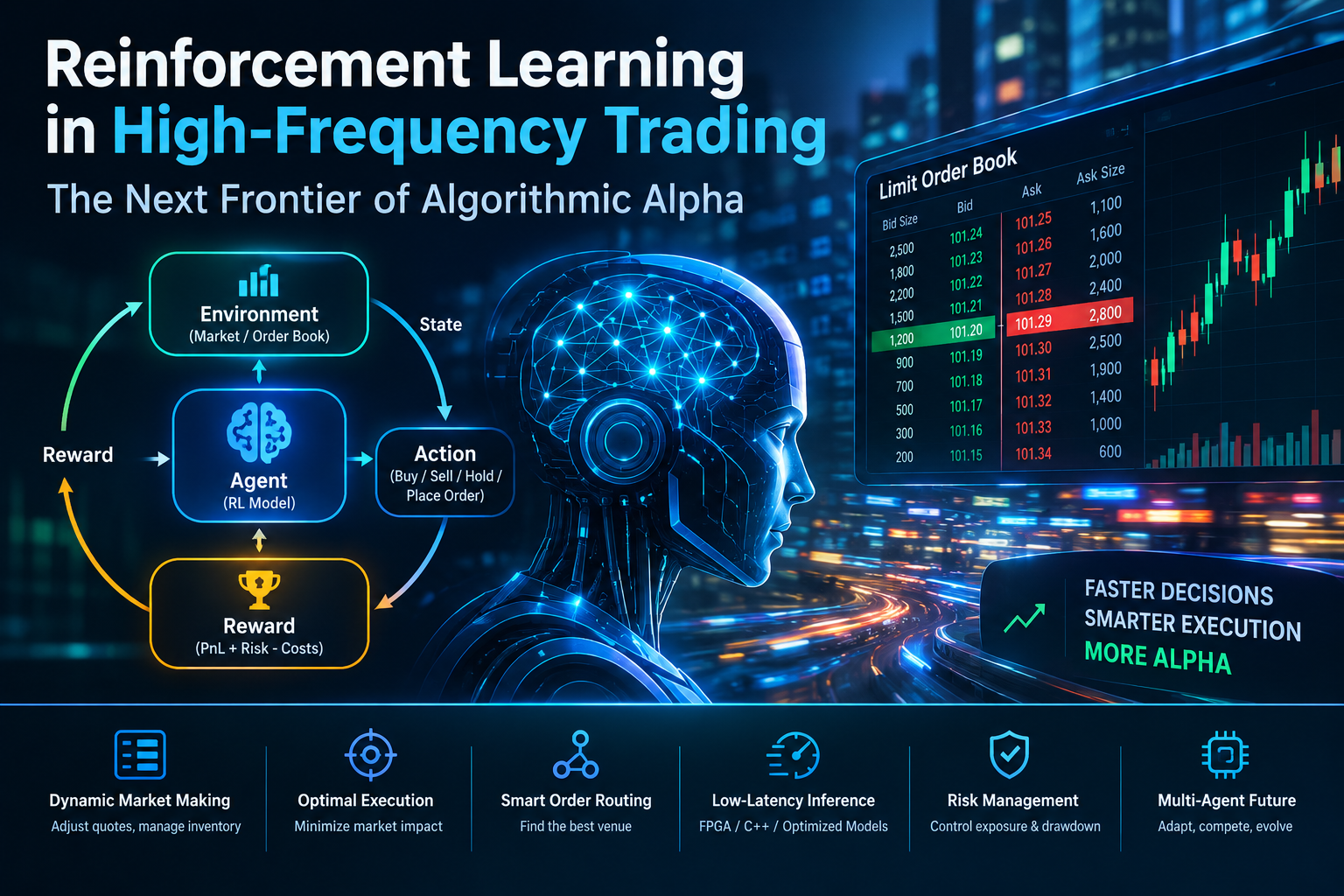
To implement reinforcement learning within an HFT context, the dynamic interaction between the trading algorithm and the matching engine must be formalized as a continuous or discrete-time Markov Decision Process (MDP), defined by the tuple (S, A, P, R, γ).
State Space (S)
In high-frequency environments, the state space S_t extends far beyond simple technical indicators. It captures high-dimensional feature vectors derived directly from Level 2 and Level 3 market data:
- Limit Order Book (LOB) Shape: Bid/ask prices, available liquidity depth across $N$ price levels, and bid-ask spread.
- Order Flow Imbalance (OFI): Microsecond-level volume pressure calculated from incoming limit orders, cancellations, and market executions.
- Queue Position: Estimated ordinal position of the agent's passive orders within the order book FIFO queue.
- Inventory & Exposure: The current net position state, unexecuted order duration, and current unrealized PnL.
Action Space (A)
The action space A_t defines the precise tactical interventions available to the agent at microsecond frequency:
- Posting limit orders at specific tick levels relative to the mid-price.
- Canceling or modifying active resting orders.
- Executing aggressive market orders to instantly cross the spread and flatten toxic inventory.
- Sizing orders dynamically to balance execution fill rates against adverse selection risk.
Reward Function (R) and Discount Factor (γ)
Designing an effective reward function R_t is crucial to preventing unintended agent behaviors (such as excessive turnover or catastrophic inventory drawdowns). A robust continuous reward formulation typically incorporates realized PnL, unrealized mark-to-market valuations, and explicit variance/inventory penalty terms:
R_t = ΔPnL_t - α * (Inventory_t)^2 - β * Transaction_Costs_t
Here, α represents the risk-aversion coefficient penalizing unhedged directional exposure, while β accounts for exchange fees and crossing spreads.
3. Key Applications of RL in Market Microstructure
A. Dynamic Market Making and Inventory Control
Traditional market makers profit from the bid-ask spread while attempting to maintain inventory neutrality. However, asymmetric information exposes them to adverse selection—the risk of filling orders right before a sharp market movement against their position.
DRL algorithms, specifically continuous action algorithms such as Proximal Policy Optimization (PPO) and Deep Deterministic Policy Gradient (DDPG), dynamically adjust quote depths and asymmetric spreads based on real-time order flow toxicity. By learning deep spatial representations of LOB imbalances, RL market makers anticipate incoming toxic flow and shift their quotes back to avoid toxic fills, drastically reducing inventory drawdown during volatile regimes.
B. Optimal Execution and Smart Order Routing (SOR)
Executing large institutional block orders without incurring significant market impact (price slippage caused by one's own trading volume) remains a fundamental quantitative challenge. Standard TWAP (Time-Weighted Average Price) and VWAP (Volume-Weighted Average Price) algorithms execute slices predictably, making them targetable by predatory HFT algorithms.
RL agents trained on high-frequency LOB states dynamically modulate their execution schedule. If liquidity is deep and toxic flow is low, the RL agent increases execution speed; if spreads widen or liquidity thins, it pauses execution or routes orders to alternative dark pools. This continuous adaptation minimizes implementation shortfall far more effectively than static parametric curves.
4. Overcoming Technical and Hardware Latency Constraints
Deploying deep neural networks (DNNs) within an sub-millisecond execution loop introduces significant computational latency overhead. While traditional Python-based ML frameworks incur millisecond delays, HFT competitive dynamics require end-to-end execution latency well under 10 microseconds.
Inference Acceleration Pipelines
Quant funds overcome these execution bottlenecks through sophisticated hardware-software co-design:
- FPGA Acceleration: Quantized RL policy networks (e.g., 8-bit integer quantized multi-layer perceptrons) are compiled directly into Field Programmable Gate Arrays (FPGAs) using High-Level Synthesis (HLS), executing model inference in single-digit nanoseconds.
- C++ Inference Engines: Models trained in PyTorch or TensorFlow are exported to ONNX or TensorRT runtimes and executed natively within low-latency C++ trading engines, utilizing SIMD (Single Instruction, Multiple Data) vectorization.
- Model Compression: Heavy transformer-based LOB encoders are distilled into compact deep feedforward networks or light Convolutional Neural Networks (CNNs) without losing essential spatial features.
5. Production Challenges: Non-Stationarity and Overfitting
Despite its vast potential, applying reinforcement learning to real-world financial markets presents severe domain-specific hurdles:
1. Non-Stationary Market Regimes
Unlike board games like Chess or Go where rules remain fixed, financial markets are non-stationary, evolving systems populated by competing, adaptive counterparties. An optimal execution strategy learned during a low-volatility regime will perform poorly during a sudden macroeconomic shock.
2. Sample Inefficiency and Simulation-to-Reality (Sim-to-Real) Gap
RL agents require millions of interactions to converge. Relying solely on historical market data leads to severe backtest overfitting: an agent's historical actions would have altered the real historical order book sequence, an effect static backtesting cannot measure. To address this, top-tier quantitative desks build high-fidelity, multi-agent historical limit order book simulators that model counterparty reactions to order placement, queue shifts, and cancellations in real time.
6. Conclusion: The Emerging Multi-Agent Dynamic
Reinforcement learning is fundamentally reshaping high-frequency trading from a domain dominated by rigid, hardcoded statistical rules into an ecosystem of self-evolving, autonomous agents. As these RL models deploy broadly across global exchanges, market interactions are shifting toward a Multi-Agent Reinforcement Learning (MARL) equilibrium, where algorithms continuously adapt to and counteract rival AI strategies.
Quantitative firms that successfully overcome the dual hurdles of reward design and sub-microsecond hardware acceleration will capture sustainable alpha, defining the future of automated financial markets.
Comments (0)
Be the first to share your thoughts on this story.