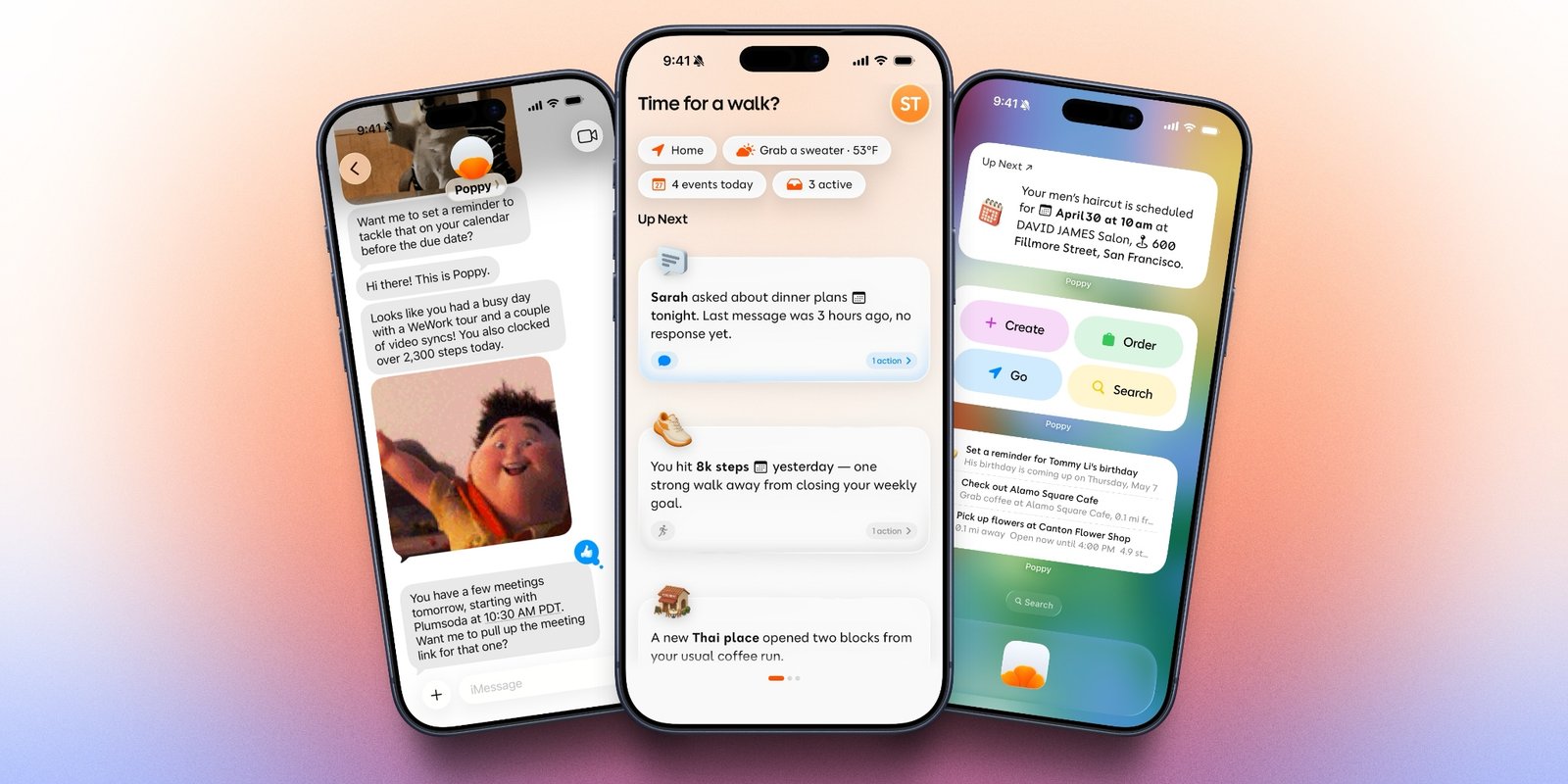
In this week’s Indie App Spotlight, we take an in-depth look at Poppy, a remarkable new personal intelligence assistant for iOS and macOS that accomplishes what Apple’s native Siri still struggles to deliver: genuinely proactive, context-aware digital assistance. Developed by an independent software team, Poppy bypasses the rigid voice-command paradigms of legacy voice assistants in favor of an ambient, proactive background intelligence framework. Rather than waiting passively for a wake word, Poppy silently observes user workflow patterns, contextual communications, and calendar obligations, stepping forward with timely automations and intelligent problem resolution before the user even thinks to ask.
What immediately distinguishes Poppy from conventional AI wrappers is its deep, system-level local contextual awareness. Leveraging Apple’s native APIs alongside optimized on-device small language models, Poppy maintains an encrypted, rolling episodic memory of user activity across applications. If a user receives an email detailing flight reservations, Poppy doesn't simply log a static calendar event; it cross-references the itinerary against real-time weather forecasts, checks local airport traffic congestion via transit APIs, automatically drafts an out-of-office autoreply in Mail, and queues up travel documentation within a single glanceable dynamic widget. Its ability to execute complex, multi-step tasks across third-party software without brittle manual Shortcut scripting is a revelation.
The app’s proactive intelligence stands in stark contrast to the iterative improvements of Apple’s native Siri and the phased rollout of Apple Intelligence features. While platform holders have focused primarily on polished conversational aesthetics and basic notification summaries, Poppy addresses real-world cognitive load. The assistant features an intelligent triage engine capable of synthesizing unread messages across Slack, Messages, and email clients into actionable executive briefings, categorized not by arrival timestamp, but by urgency and contextual importance. Users can instruct Poppy to autonomously negotiate meeting times via email, follow up on unpaid invoices, or remind them to call family members during specific commute windows.
Crucially, the developers behind Poppy recognized that proactive access to personal data demands an uncompromising privacy architecture. The app operates under a local-first processing philosophy. Sensitive contextual indexing, daily schedule analysis, and initial conversational intent parsing are processed entirely on-device using quantized neural engine models, never leaving the user’s hardware. When advanced generative synthesis or heavy reasoning tasks require high-capacity cloud compute, data payloads are anonymized, end-to-end encrypted, and processed on dedicated zero-retention servers, preventing personal telemetry from being harvested or utilized to train external artificial intelligence models.
Poppy represents the quintessential indie software triumph: an agile, laser-focused product that outmaneuvers trillion-dollar platform holders by solving fundamental usability problems with technical elegance and daring ambition. While tech giants remain bogged down in bureaucratic safety reviews, platform lock-in politics, and conservative design choices, indie developers are demonstrating what truly agentic personal computing can look like today. For power users seeking an assistant that genuinely anticipates their daily cognitive needs, Poppy is a shining glimpse into the future of proactive personal operating systems.