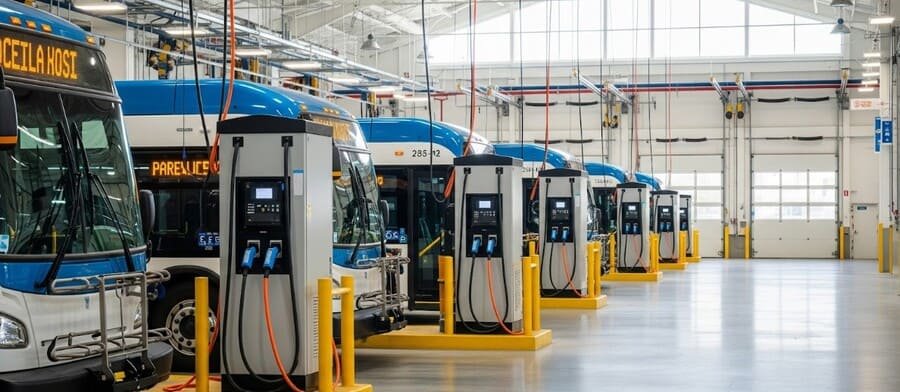
Across the globe, cities are facing mounting pressure to reduce urban emissions, improve air quality, and meet ambitious climate targets. Because public and municipal vehicles—ranging from transit buses and police cruisers to waste collection trucks and administrative sedans—are visible symbols of local government, electrifying them represents one of the most impactful decarbonization steps a municipality can take.
However, transitioning a municipal fleet from internal combustion engines (ICE) to electric vehicles (EVs) is far more complex than simply swapping vehicle models. It requires a holistic overhaul of procurement models, energy infrastructure, driver behavior, and operational workflows. For city planners, public sector administrators, and B2B fleet managers, a structured roadmap is essential to minimize service disruptions and maximize return on investment (ROI).
1. Assessing Fleet Readiness: Duty Cycles and Telematics
Before issuing requests for proposals (RFPs) for new electric vehicles, fleet managers must thoroughly understand their current operational footprint. Not all municipal roles are created equal when it comes to electrification readiness.
Conducting a Comprehensive Duty Cycle Audit
Start by collecting telematics data across your existing fleet for at least 60 to 90 days. Key metrics to analyze include:
- Daily Mileage: How far does each vehicle travel per shift? Most municipal administrative vehicles travel under 50 miles per day, making them ideal early candidates for electrification.
- Idle Time: Vehicles like police cruisers and utility trucks spend significant time idling, consuming fuel and creating unnecessary wear. EVs eliminate idling emissions entirely.
- Dwell Time and Parking Locations: Where do vehicles park overnight or between shifts, and for how long? Long overnight dwell times favor cost-effective Level 2 AC charging, whereas continuous multi-shift operations require high-power DC fast chargers (DCFC).
"Electrification isn't a simple 1:1 replacement; it's an operational redesign. Telematics data provides the empirical foundation needed to avoid over-specifying battery sizes or overbuilding charging capacity."
2. Infrastructure Planning: Power, Grid Capacity, and Smart Charging
The single biggest bottleneck in municipal fleet electrification is rarely the vehicles themselves—it is the charging infrastructure and grid interconnection.
Partnering Early with Electric Utilities
City planners must engage local electric utilities at the outset of the planning phase. Upgrading electrical service panels, adding transformers, or extending distribution lines can take anywhere from six months to two years depending on utility supply chain queues.
Right-Sizing Charging Architecture
Municipal depots require a strategic mix of charging hardware:
- Level 2 Chargers (7kW - 19kW): Best suited for depot-bound vehicles with 8+ hours of overnight downtime, such as inspector sedans and code enforcement units.
- DC Fast Chargers (50kW - 350kW): Necessary for emergency vehicles, multi-shift transit buses, and heavy-duty specialty trucks that require rapid turnaround times.
Deploying Smart Charge Management Software (CMS)
Uncontrolled simultaneous charging of an entire fleet can trigger massive utility demand charges. Smart CMS orchestrates charging schedules based on electricity tariffs (Time-of-Use rates), vehicle priority schedules, and real-time grid constraints, lowering operational energy costs by up to 40%.
3. Total Cost of Ownership (TCO) & Strategic Financial Modeling
While the initial capital expenditure (CapEx) for electric vehicles and charging stations is higher than traditional ICE counterparts, the lower operational expenditure (OpEx) creates a compelling financial case over the vehicle lifecycle.
Analyzing the Capital vs. Operational Equation
Electric motors feature far fewer moving parts than internal combustion engines, resulting in lower maintenance expenses—up to 40% less for routine servicing, brake wear, and fluid changes. Furthermore, electricity costs per mile are significantly more stable and predictable than volatile fossil fuel prices.
Leveraging Funding, Incentives, and Innovative Procurement
To offset upfront CapEx, fleet managers should explore multiple funding avenues:
- Federal and Regional Grants: Programs like the U.S. EPA Clean School Bus Program or state-level zero-emission transit grants offer substantial capital relief.
- Energy-as-a-Service (EaaS) & Fleet-as-a-Service (FaaS): These emerging business models allow municipalities to convert heavy upfront infrastructure costs into manageable, predictable operational fees paid to third-party providers.
- Carbon Offsets and Monetization: Depending on the jurisdiction, low-carbon fuel standards (LCFS) allow municipalities to generate and sell carbon credits for every kilowatt-hour of clean energy dispatched to their fleet.
4. Workforce Upskilling and Change Management
A successful transition relies heavily on the people operating and maintaining the equipment. Change management must be prioritized alongside engineering.
Driver Education and Eco-Driving Techniques
Drivers accustomed to gasoline or diesel vehicles need training on regenerative braking, smooth acceleration techniques, and cabin pre-conditioning while plugged in. Proper driver training can extend EV range by 15% to 20% per charge.
Upgrading Maintenance Technician Skillsets
Municipal maintenance shops must pivot from traditional mechanical overhauls to high-voltage electrical safety, diagnostic software troubleshooting, and battery management system monitoring. Investing in technician certification ensures safety and reduces reliance on expensive dealership service contracts.
5. Phased Rollout Strategy: A Scalable Roadmap
Attempting to convert an entire municipal fleet overnight introduces unnecessary operational risk. A phased, iterative approach yields the best long-term outcomes.
- Phase 1: Pilot Program (Months 1–12): Electrify 5% to 10% of light-duty, predictable-route vehicles. Install foundational charging units and test telematics and CMS integration.
- Phase 2: Scale Light-Duty & Medium-Duty (Months 13–36): Expand across department sedans, light vans, and park maintenance trucks. Upgrade central depot grid capacity.
- Phase 3: Heavy-Duty & Specialty Integration (Months 37+): Introduce electric refuse trucks, heavy transit buses, and emergency support vehicles as technology matures and charging infrastructure expands.
Conclusion: Moving Urban Mobility Forward
Electrifying municipal fleets is a multi-year journey that bridges urban planning, public policy, energy management, and financial strategy. By grounding decisions in data, collaborating early with utilities, and taking a phased implementation approach, city planners and B2B fleet managers can pave the way toward cleaner, quieter, and more cost-effective cities for generations to come.
Comments (0)
Be the first to share your thoughts on this story.