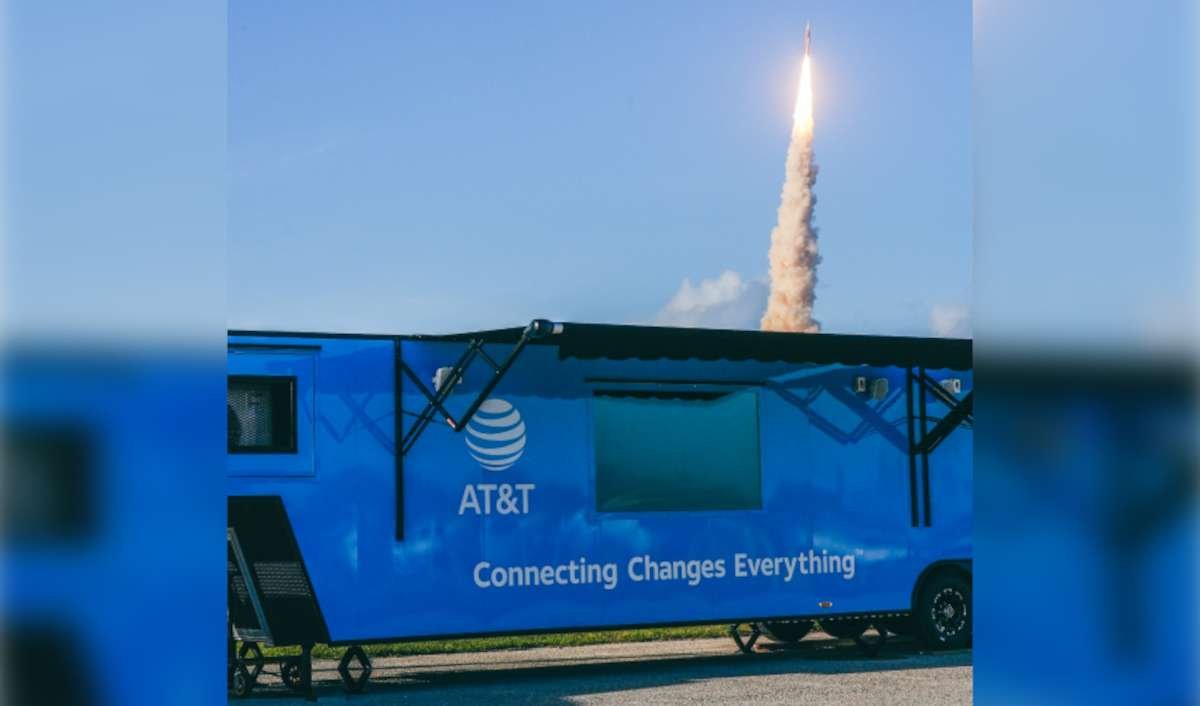
As the global aerospace community eagerly monitors the historic progress of NASA's Artemis II mission, telecommunications powerhouse AT&T and the First Responder Network Authority have quietly deployed a vast, mission-critical communications infrastructure to support humanity's return to lunar space. Extending a proud tradition of supporting national space initiatives that spans nearly a century and a half, AT&T is collaborating side-by-side with NASA engineers to ensure uninterrupted, ultra-secure voice, data, and video telemetry throughout every critical phase of the crewed lunar flyby.
The operational scale required to support an undertaking as complex as Artemis II is staggering. Linking mission control at Johnson Space Center in Houston, launch facilities at Kennedy Space Center in Florida, and worldwide deep-space tracking stations requires redundant, ultra-low-latency fiber-optic corridors capable of transferring terabytes of telemetry data every second without packet loss. AT&T's hardened commercial network backbone provides the resilient foundation for these multi-point operational links, ensuring that telemetry flowing from the Orion capsule through NASA's Deep Space Network is transmitted instantly to flight directors and scientific teams around the clock.
Beyond traditional fixed telecommunications, FirstNet—the nationwide, high-speed wireless broadband network built specifically for public safety in a public-private partnership with AT&T—is playing an indispensable role in mission recovery operations. When Orion completes its lunar loop and executes its high-speed atmospheric re-entry, the spacecraft will splash down into the vast expanse of the Pacific Ocean. A recovery fleet comprised of United States Navy amphibious transport ships, specialized Air Force rescue parajumpers, and NASA recovery specialists must coordinate instantaneously under harsh oceanic conditions to retrieve the four astronauts and secure the capsule.
To support this high-stakes maritime recovery operation, FirstNet has deployed specialized private cellular infrastructure, satellite backhaul terminals, and dedicated Band 14 wireless spectrum across the operational recovery zone. This dedicated communications bubble provides recovery teams with priority access and preemption, ensuring that search-and-rescue teams, flight surgeons, and maritime craft can transmit encrypted biometric vital signs, ultra-high-definition video feeds, and mission-critical telemetry without interference from public cellular traffic. Even in remote oceanic locations where civilian networks cannot reach, FirstNet's mobile satellite assets maintain uninterrupted operational command.
The collaboration between NASA and AT&T highlights how vital commercial telecommunications partnerships have become to the modern space economy. As the Artemis program progresses from orbital test flights toward sustained lunar basecamps and eventual crewed expeditions to Mars, the requirement for robust, interplanetary communications architectures will only expand. By proving that terrestrial public safety networks and deep-space telemetry backbones can seamlessly integrate under the most demanding real-world conditions, AT&T and FirstNet are helping lay the technological groundwork for humanity's permanent expansion into deep space.